Post · June 8, 2026
Why this begins at the end
Two pictures I could never get out of my head, and why they ended up shaping a portfolio built like a star.
I didn’t start with a philosophy. I started with two pictures I could never quite get out of my head.
The first is a black hole. Not the famous 2019 photograph, but a drawing from 1979. A young CNRS researcher named Jean-Pierre Luminet calculated what a black hole would actually look like, the way its gravity would sling the light of its own disk around it, brighter on one side than the other. There were no printers that could render it, so he placed the shading by hand, dot by dot, in ink. It was not an artist’s impression. It was physics, drawn by a person who cared enough to draw it.
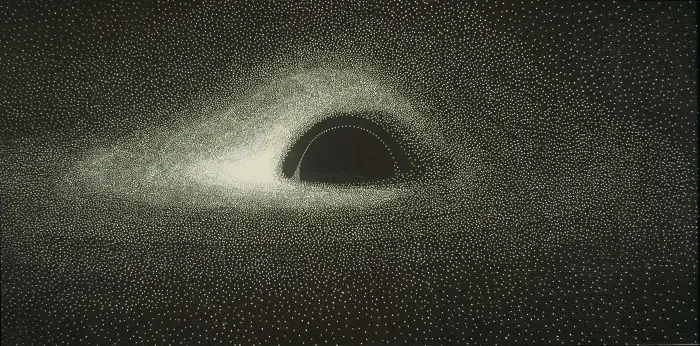
Jean-Pierre Luminet, the first black hole simulation, 1979. (c) Jean-Pierre Luminet / Observatoire de Paris / CNRS.
Source: CNRSThe second is gold. The Voyager Golden Record, bolted to a probe that left our solar system and will outlive every one of us. A disk engraved with how to find Earth and what we sounded like, flung into the dark on the off chance that someone, someday, finds it. A message with no expectation of a reply.
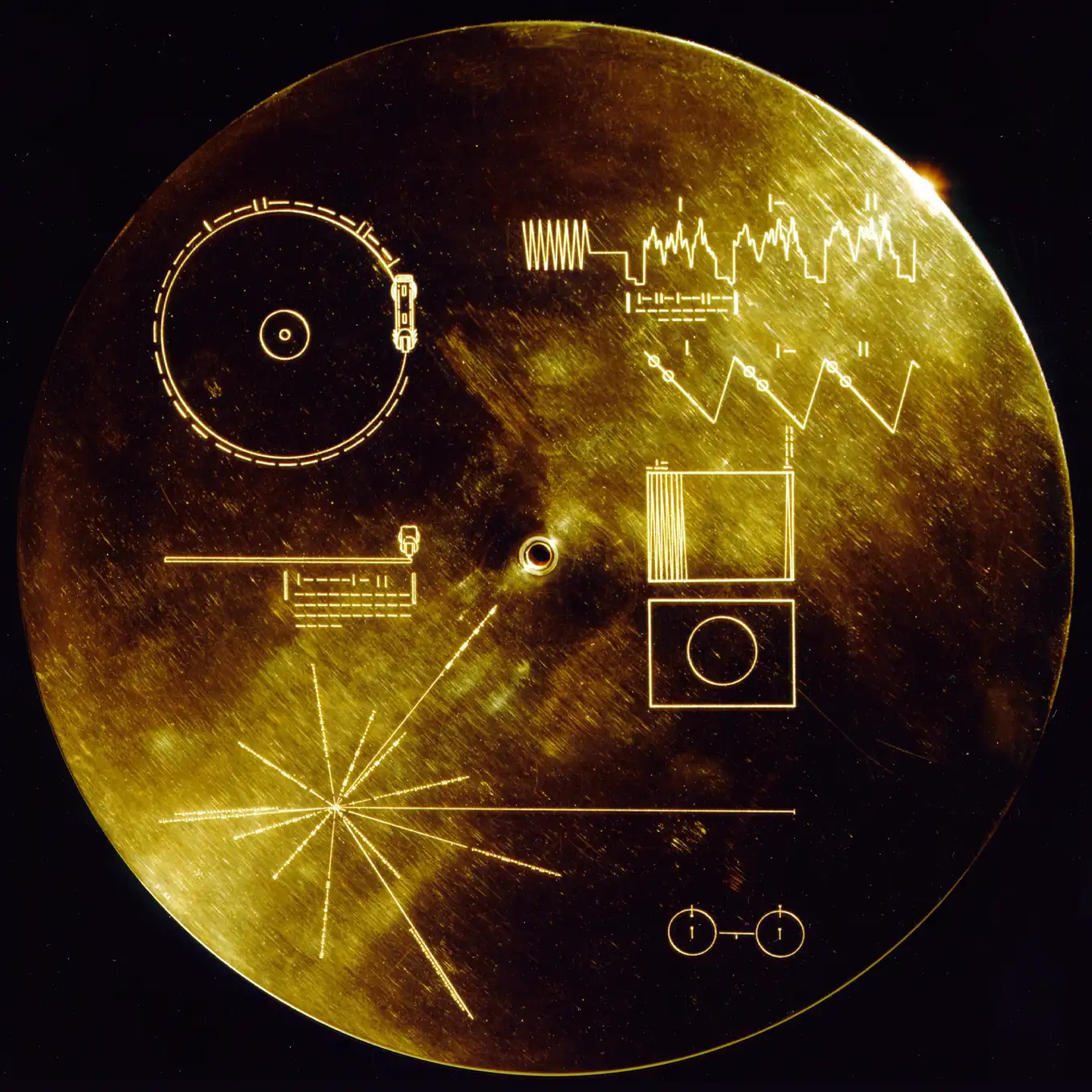
The Voyager Golden Record, NASA/JPL, 1977.
Source: NASA/JPLI realized those two things are the same thing. Both are points of light against a void. Both are someone deciding to build something carefully, honestly, and meant to last longer than they will. That is the whole reason this site looks the way it does. A million points of light, a star living its life in reverse, and the black hole right at the top — the page opens on the collapse and rewinds to a lone pale blue dot at the bottom. I wanted to make Luminet’s drawing move.
But once the star existed, the metaphor started telling me the truth.
A star’s life is honest in a way that portfolios never are. It doesn’t show you only the clean yellow burn. It shows you the bloat, the overreach, the collapse. A star that displayed only its good years would not be a star. It would be a lie about one. And that is exactly what most developer portfolios are: a wall of wins, every screenshot cropped to hide the part that didn’t work.
So the form made the choice for me. If I was going to put my work inside a star’s life, I had to include the collapse. That is the graveyard.
And the dead projects are where I actually learned. KeywordLens taught me you can execute well and still be standing on ground that is about to move. HeyDaniel taught me I will pour months of engineering into a problem before checking whether anyone else has it. The wins are just the part where I had already learned the lesson. Hide the failures and you hide the only interesting part.
I think this matters more now, not less. Anyone can generate infinite code. What is scarce is judgment: knowing what is worth building, and the honesty to say when something was not. A graveyard is judgment with the receipts attached.
So that is what this is. Not a highlight reel. A full lifecycle, drawn dot by dot, meant to last a little while and be honest about what didn’t.
This begins at the end on purpose. The collapse comes first, because that is usually where the honest part is.