
The work that held.

Tools I built, shipped, and still stand behind.

Fleet

github.com/ilies-bel/fleet npm @ilies-bel/fleet
Role
Solo — design, build, ship
Stack
Containers · gateway proxy · git worktrees
Status
Open source · shipped
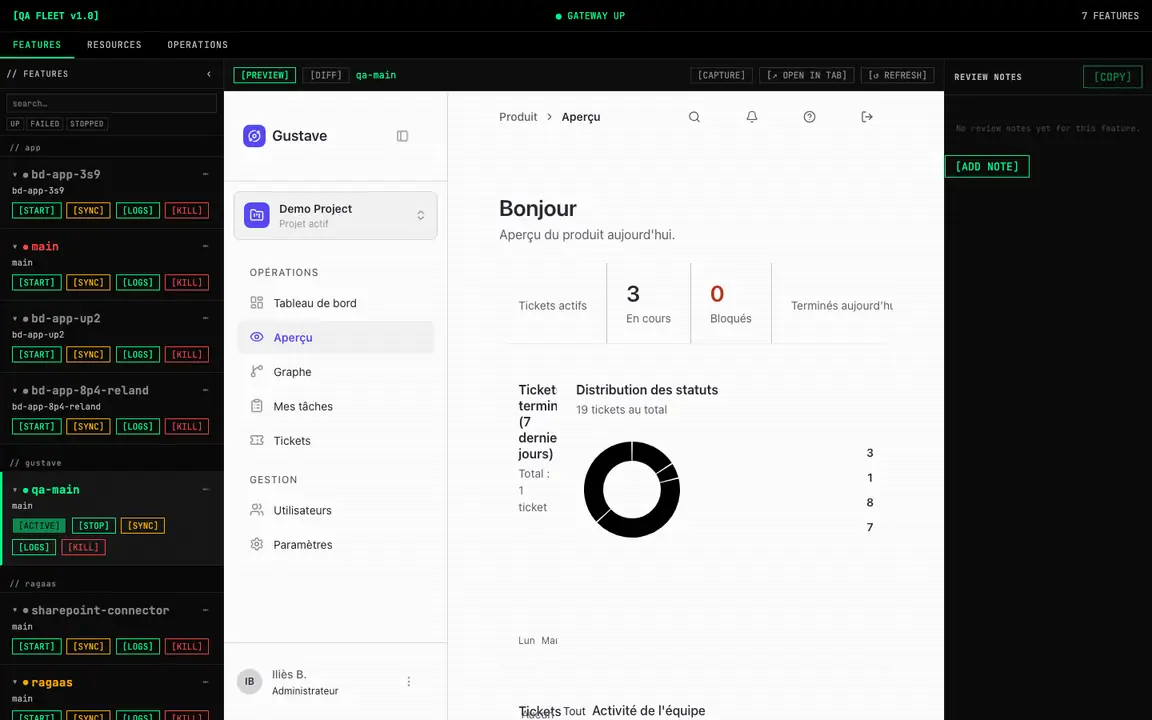
Fleet dashboard showing multiple feature branches running in parallel containers
Fleet: parallel branch preview dashboard

The problem

Reviewing several feature branches at once meant constantly tearing down and rebuilding one local environment. Every switch threw away a working setup, and the rebuild ate the time the review was supposed to save.

The decisive choice

Stop rebuilding and run them all: every feature branch of your app at the same time on localhost, each in its own container behind a gateway. Fleet auto-detects the stack and manages multiple repos through git worktrees.

The outcome

One dashboard to spin branches up, tail logs, preview the running app, diff UI states, and leave QA notes per feature — you flip between branches instead of rebuilding one. The container orchestration, the gateway proxy, the stack auto-detection, and the diff view all had to work together, and they do. It is a real tool, not a demo.

Proof

  • It has users among the niche it was built for — engineers doing parallel QA.

    evidence being gathered

Decisions & consequences

Paths not taken

  • One shared local environment, torn down and rebuilt per branch — the workflow Fleet replaced. Rebuilding for every review is exactly the cost the tool exists to delete.

Known limits

  • Niche by design — it only earns its keep when you review several branches in parallel; a one-branch-at-a-time workflow gains nothing.
  • Stack auto-detection covers the common setups; an exotic build still needs manual container config.

Current status

Shipped and open source — the code and the npm package are public.

Mars private

B2B product. No public link.
Role
Solo — design, build, ship
Stack
Multi-agent orchestration · task graph
Status
Private · in use
Mars agent task topology A directed graph of thirteen agent tasks for the goal "feature/auth-v2": three planning tasks resolved as merged, two integration tasks merged or coding, a failed accessibility task that triggered a retry now coding, downstream verify and queued tasks, all converging on a final queued merge step. Nodes are colour-coded by lifecycle state (queued, coding, verify, merged, failed) and edges are blocker dependencies. AGENT TASK TOPOLOGY RUN #214 · 13 TASKS · 1 RECOVERY GOAL feature/auth-v2 T01 schema T02 api-spec T03 layout T04 migrate T05 endpoints T06 ui-shell T07 a11y T08 telemetry T09 a11y-retry T10 contract T11 e2e T12 merge QUEUED CODING VERIFY MERGED FAILED
Mars: agent task topology — tasks coloured by lifecycle state, edges are blocker dependencies.

The problem

Coordinating many agents so they do the right work in the right order — and recover when a step fails — is a genuinely hard orchestration problem.

The decisive choice

Make the goal the only input. Give Mars a goal and it builds a web of tasks, figures out the order they have to run in, and executes the whole graph autonomously: writing code, recovering from failures, and chaining the follow-up work without a human in the loop.

The outcome

A local AFK agent swarm for software work — the most ambitious thing I have built, and it does it. The topology view lets you watch the dependency web plan and run itself in real time; the diagram here mirrors it — nodes are tasks, edges are blocker dependencies, colours are lifecycle state, and the failed branch shows a recovered task picked up by a follow-up agent.

Proof

  • Mars is in production use with its client.

    evidence being gathered

Decisions & consequences

Paths not taken

  • Keeping a human in the loop for ordering and recovery — the point was AFK operation, so the task graph had to plan and run itself.

Known limits

  • Private by contract — there is no public demo, so every capability claim rests on this page's word.
  • Recovery handles failed tasks, not failed PLANS — a mis-decomposed goal still needs a human to restate it.

Current status

Private B2B product, delivered to its client — no public demo by contract.